
Margaret Atwood’s Most Acclaimed Adaptation Is A Miniseries Tucked Away On Netflix
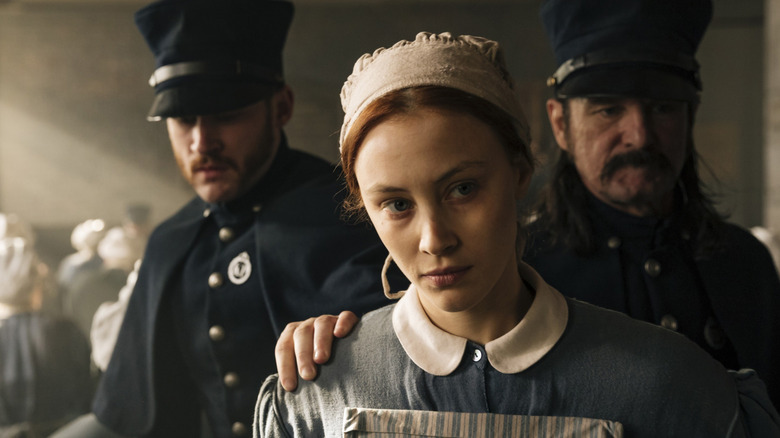
Love “The Testaments” and “The Handmaid’s Tale?” Don’t sleep on “Alias Grace,” a truly excellent miniseries that’s based on a lesser-known Margaret Atwood book and lives exclusively on Netflix. What’s more, it’s the most acclaimed Atwood adaptation yet, with a 99% critical score on Rotten Tomatoes. “Biting social commentary and Sarah Gadon’s hypnotic performance make ‘Alias Grace’ a worthy addition to the Margaret Atwood adaptation catalog,” to quote RT’s critics consensus.
Inspired by a real murder case that shook Atwood’s home country of Canada in the 1800s, “Alias Grace” centers on Grace Marks, portrayed by Gadon (one of David Cronenberg’s regular collaborators). As the story begins, Grace is accused of a grievous crime — specifically, the murder of her former employer Thomas Kinnear (Paul Gross) and his housekeeper Nancy Montgomery (Oscar-winner Anna Paquin). As a psychiatrist named Simon Jordan (Edward Holcroft) speaks to Gadon to try and determine how, why, or even if she carried out this double murder, we’re shown Grace’s story from the beginning, including her immigration from Ireland to Canada and everything that followed.
If you liked the Netflix sensation “Adolescence,” then you’ll definitely get invested in a deliciously dark and gripping show like “Alias Grace.” Plus, if you’re a fan of writer/director Sarah Polley (who won an Oscar for the adapted script for 2022’s “Women Talking” and appeared in a hysterically funny episode of Seth Rogen’s comedy series “The Studio” in 2025), you’ll love “Alias Grace,” because she wrote every episode. And in case I haven’t fully sold you on this miniseries, it’s also directed by Mary Herron, the filmmaker behind “American Psycho” and “The Notorious Bettie Page.” Again, “Alias Grace” is on Netflix now … and if you’re new to adaptations of Atwood’s work, you’re in luck. She’s got a bunch, and they’re all really good.
Alias Grace has always been overshadowed by The Handmaid’s Tale

As terrific as “Alias Grace” is, it’s always been overshadowed by “The Handmaid’s Tale” — and by that I mean the Margaret Atwood novel published in 1985 and the defining work of her career. It is, without question, one of the most famous modern classics in the sci-fi literary canon. (Anecdotally, when I was in high school, we got to choose summer reading pairs; I chose “The Handmaid’s Tale” because it was paired with George Orwell’s “1984,” which I’d already read. Thankfully, “The Handmaid’s Tale” rocked, and I was hooked.) The novel takes place in a world where a totalitarian religious regime has overtaken the continental United States and rechristened it Gilead, creating a society where women are fully oppressed; they can’t read, write, own property, vote, or have a bank account, and certain factions of women, like our protagonist June, become “Handmaids.”
As a Handmaid, June’s name is erased (she’s given the name “Offred,” pronounced “of Fred,” as she belongs to a high-ranking Gilead commander named Fred), and she’s merely a vessel for childbearing in a world where fertility rates are plummeting and fertile women are prized above all else. After a lackluster movie adaptation that Atwood pretty openly despised came out in 1990, showrunner Bruce Miller adapted “The Handmaid’s Tale” as a Hulu series starting in 2017, and the rest is history. “Mad Men” star Elisabeth Moss spearheads the show as the woman formerly known as June, with Joseph Fiennes playing Fred and Yvonne Strahovski co-starring as his wife, Serena Joy. The series went on to win a whole armload of Emmys for everyone involved. Then, in 2026, Miller brought audiences back into Gilead … and based that project on Atwood’s long-awaited sequel to “The Handmaid’s Tale.”
Margaret Atwood’s work is timeless — and Hulu’s The Testaments proves just that

In March 2026, the Hulu series “The Testaments” debuted, using Margaret Atwood’s 2019 sequel to “The Handmaid’s Tale” as its source material and bringing viewers back to Gilead … although there’s a big difference right out of the gate. While June, in “The Handmaid’s Tale,” existed in a world before Gilead and understands precisely how oppressed she is as a woman, her biological daughter Hannah, now known as Agnes MacKenzie (“One Battle After Another” breakout Chase Infiniti), was raised in Gilead and has no idea that there’s freedom across the Canadian border. (Agnes, née Hannah, was stolen from June as the commanders of Gilead rose to power.) Agnes, who’s about to become an eligible bachelorette in Gilead’s society, is thus startled when she’s asked to help initiate a new girl named Daisy (Lucy Halliday), who’s presented as a Pearl Girl that hopes to join Gilead in full.
That’s not true. Daisy was kidnapped from Canada and smuggled into Gilead, and here’s something even more tantalizing: she knows June (Elisabeth Moss reprises the character in “The Testaments,” tying the two shows together). Thankfully, Atwood really likes this adaptation and even says that she filmed a small cameo role for the series, so add this to your watchlist if you want to explore all the screen versions of this Canadian author’s work. As for “Alias Grace,” that’s streaming on Netflix.


