
The Nine-Brained Breakout Star: How Marcellus the Octopus Steals the Heart of “Remarkably Bright Creatures”
A closer look at the cinematic magic, scientific mystery, and emotional depth behind the screen’s most unconventional leading marine character.

While the powerhouse pairing of Hollywood icon Sally Field and rising star Lewis Pullman provides the human emotional anchor for Olivia Newman’s upcoming film Remarkably Bright Creatures, the true soul of the story belongs to a resident of the deep: Marcellus, a remarkably intelligent Giant Pacific Octopus.
Adapting Shelby Van Pelt’s beloved bestselling novel meant facing a massive cinematic hurdle: how do you translate a cynical, highly observant, and non-human narrator into a live-action film without losing his magic? As early reactions move audiences to tears, it is clear that Marcellus is set to become one of the most memorable marine characters in modern cinema.

1. The Power of Scientific Mystery and Fantasy
In creating the original story, author Shelby Van Pelt intentionally chose a Giant Pacific Octopus because the species occupies a unique space in human consciousness—they are scientifically brilliant yet deeply mysterious.
-
A Touch of Fantasy: Because marine biology is still uncovering the depths of octopus intelligence, Van Pelt found the perfect sweet spot for artistic liberty. Marcellus isn’t just an animal in a tank; he is a sentient entity with three hearts and nine brains, acutely aware of his surroundings and his human captors.
-
The Ticking Clock: Giant Pacific Octopuses have a notoriously short lifespan (typically 3 to 5 years). In the film, Marcellus is nearing the end of his days, adding a poignant, unspoken layer of grief and urgency to his character. He knows his time is running out, which drives his nighttime escapades and his urge to intervene in the lives of the humans around him.
 2. Bringing Marcellus to Life: CGI Blended with Cosmic Oceanography
To make Marcellus feel like a living, breathing co-star rather than a digital effect, director Olivia Newman eschewed standard green-screen reliance in favor of a more grounded, immersive visual approach.
The Visual Strategy: Newman utilized extensive, breathtaking underwater footage captured by local divers. By blending high-end CGI with real-world marine physics, the film makes the ocean environment feel as vast, terrifying, and wondrous as outer space.
Every ripple of Marcellus’s skin, the color shifts used to communicate his mood, and the calculated movement of his tentacles were meticulously designed to reflect genuine octopus behavior while subtly conveying his internal monologue. The result is a creature that feels entirely organic to his environment, drawing the audience into his aquatic perspective.
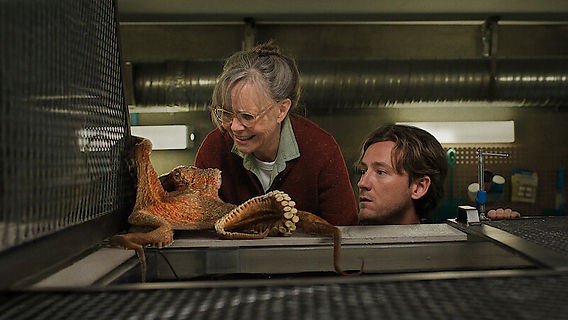 3. An Unlikely Alliance: The Silent Chemistry with Sally Field
The emotional peak of the film rests on the quiet, midnight interactions between Marcellus and Tova Sullivan (Sally Field), the aquarium’s night cleaner. Both characters are defined by their isolation: Tova is a fiercely independent woman trapped in her own lifelong grief, while Marcellus is a genius trapped in a glass cage.
Marcellus’s habit of escaping his enclosure to forage for food and collect human trinkets becomes the catalyst for their bond. Tova treats him not as a specimen, but as a confidant. The natural chemistry between Field and her digital marine co-star is a testament to the film’s directional triumph—creating a profound sense of mutual understanding that ultimately holds the key to unlocking the story’s central, decades-old mystery.
The Verdict: Marcellus is far more than a visual gimmick. He stands as a beautiful metaphor for the unseen depth within all of us, proving that sometimes, it takes a creature from a completely different world to help us understand our own.


