
A new scientific study has just been published, stunning the astronomy community with a chilling warning: Earth could one day be knocked off its orbit and thrown out of the Solar System altogether.
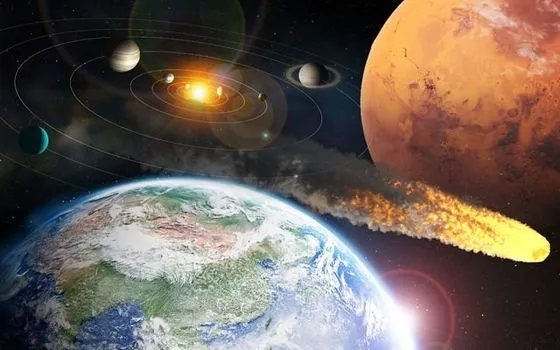 (Illustrative image: Getty Images)
Published in the journal Icarus, the study reveals that so-called “field stars” — stars that drift close to the observation area in the sky — could have a far greater impact on the stability of our Solar System than previously assumed.
Based on thousands of computer simulations, the research team led by astronomers Nathan Kaib and Sean Raymond found that if a star with a mass similar to our Sun were to pass through a region about 10,000 astronomical units (AU) away from the Solar System — more than 200 times the distance from Earth to the Sun — it could cause significant disturbances in the Solar System’s outermost region, specifically the Oort Cloud.
The Oort Cloud is an immense spherical shell filled with icy bodies, considered the “final shield” encasing our Solar System, far beyond Pluto. Disturbances here could trigger a chain reaction that affects the orbits of the inner planets, including Earth.
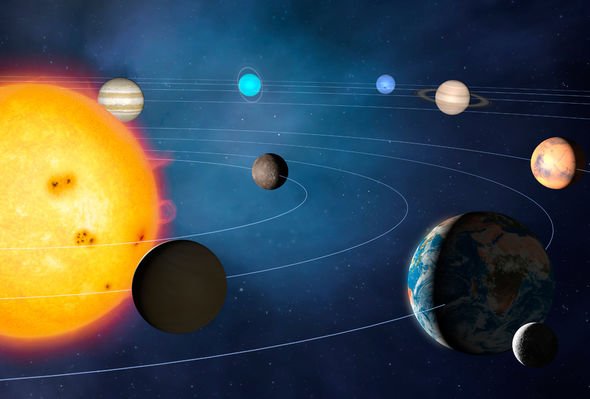
“Passing stars are the most likely agents of orbital instability within the next 4 billion years,” the study warns. Even more concerning, the research suggests that the giant planets of the Solar System and even Pluto are far less stable than we have long believed.
According to the simulations, gravitational forces from wandering stars could result in:
-
Mercury facing an increased risk of orbital instability, rising from 50% to 80%, making it more likely to be pulled off its current path around the Sun.
-
Pluto having a 5% chance of falling into gravitational chaos within the next 5 billion years.
-
Mars facing about a 0.3% chance of colliding with another planet or being ejected from the Solar System.
-
Earth, the study estimates, has a 0.2% chance of colliding with another planet or being knocked out of its orbit altogether.
One of the most alarming scenarios described is that if Mercury’s orbit becomes destabilized, it could trigger a domino effect, causing Venus or Mars to collide directly with Earth. Additionally, Earth’s orbit could shift so dramatically that it might spiral into the Sun, or worse — be pushed by Venus and Mars toward Jupiter. Due to Jupiter’s immense gravity, this could eject Earth from the Solar System forever.
Kaib and Raymond argue that traditional models have significantly underestimated how much the orbits of giant planets could change in the distant future. “The simulations show that the Solar System is not the perfectly stable structure people have long imagined. In reality, it’s far more fragile when influenced by forces from the deep universe,” the researchers wrote.
Although the chance of Earth being flung from the Solar System is only about 0.2%, over a timescale of billions of years, this remains a risk worth noting. Importantly, this study offers a fresh perspective on the potential dangers posed by distant astronomical events — threats once thought harmless to Earth.
While the idea of Earth drifting away from the Sun remains just a distant hypothetical scenario, it raises a serious question for scientists: Should we rethink how stable our cosmic home truly is?
This research also reinforces that the real threats to our planet don’t come solely from climate change or asteroid impacts, but also from far-off cosmic factors that humanity still doesn’t fully understand.
A silent passing star could one day trigger a chain reaction that sends our planet wandering aimlessly through the endless darkness of space.


